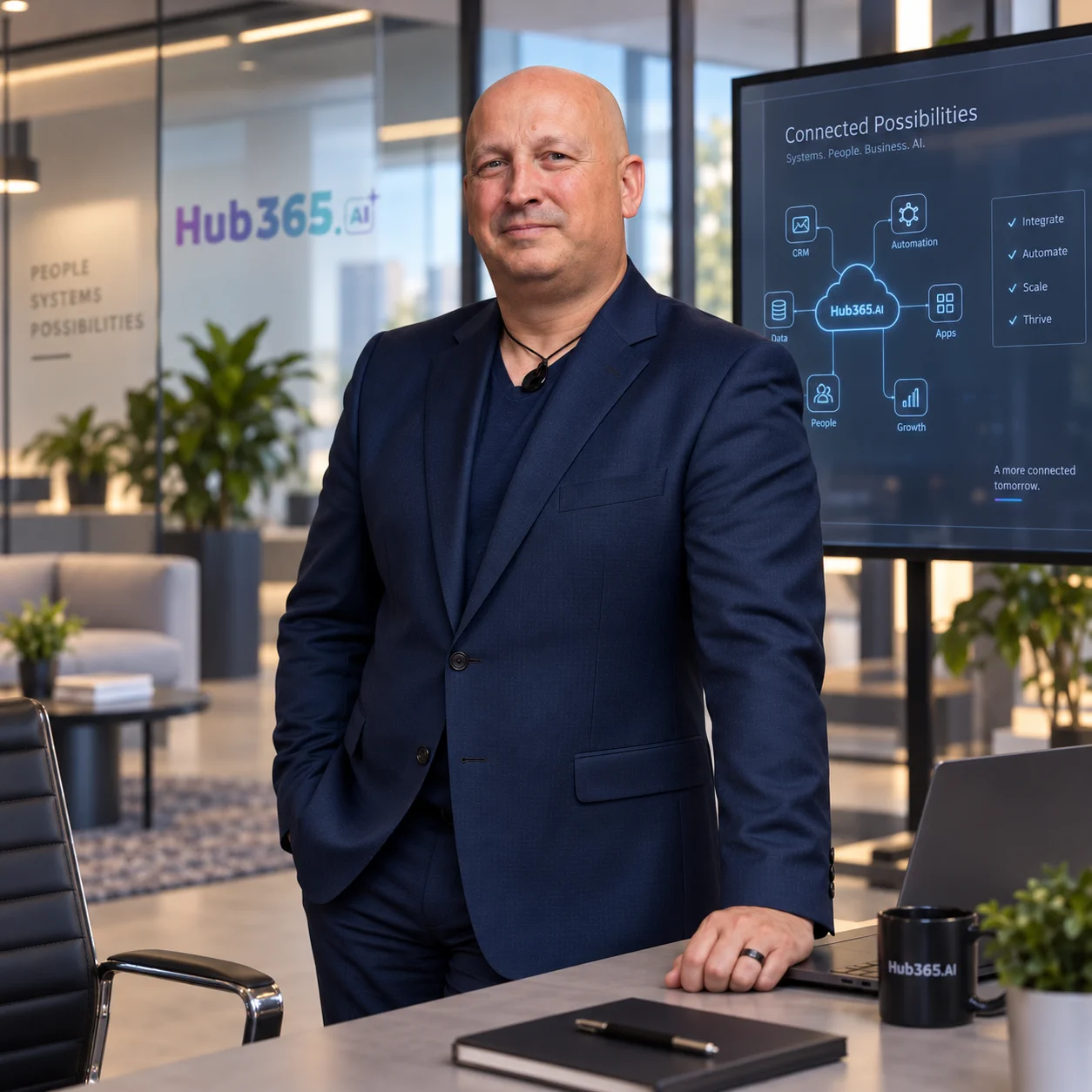
Todd Ross · Co-Founder, Hub365 AI · Fort Lauderdale
That's not a marketing problem.
That's an architecture problem.
I design and build the apps and the automated systems behind Hub365 AI.
Thirty years running projects in healthcare, technology, mining and federal government came first. Four worlds with almost nothing in common, and the same failure mode running through all of them.

1996
Computer science degree, specialized in project management
30
Years managing corporate projects across four industries
4
Iindustries: healthcare, technology, mining, federal government
3,000+
Students through my coaching programs
USMC
United States Marine Corps veteran, retired
About
Projects do not fail because somebody lacked a tool.
I came in through computer science. The degree is from 1996, and I specialized in project management on top of it.
They fail because the parts were never connected to each other and nobody owned the seam. I saw that in healthcare, in technology, in mining and inside a federal agency, long before I ever saw it in marketing.
I co-founded Hub365 AI with Naty Ross in Fort Lauderdale. She builds the strategy. I build what has to hold it up: how the pieces connect, where the points of failure are, and what happens at three in the morning when an integration drops.
Before the agency I founded my own coaching company, The Next Level Up, and coached in the Tony Robbins and Dean Graziosi mastermind. More than three thousand students came through those programs. That is where the other half of the job comes from. A system only exists if the person using it understands it.
We spent years watching good business owners drown in tools. They had the CRM, the site, the email platform, and none of it worked together. So we did not build another tool to bolt on. We built the connected ecosystem, then learned to run it for people who do not have time to.
This is not another “tech stack” list. You test what happens between the tools you already own.
How I diagnose, in about a minute
When a business is underperforming, my first question is almost never which tool is missing. It is whether the foundation is connected.
What I work on
The architecture behind the results.
App design and architecture
When a business needs something no off-the-shelf tool does, you design and build it instead of bending the business to fit the tool.
Marketing systems architecture
How the CRM, the site, the forms and the automation connect without points of failure.
Integrations and data
Where a business's data actually lives, and who genuinely owns it.
Deployment
What it takes for something to work in production, not in a demo.
Operational risk with AI
What a machine decides, what a person decides, and who signs off.
Why you can take my word for it
The receipts.
Straight answers to the questions business owners ask most about systems, automation, AI, and growth. No jargon, just practical insight based on how these tools work together in the real world.
Does LinkedIn work for a traditional business like a funeral home?
Yes. One owner put their funeral home on LinkedIn and everyone raised an eyebrow—including their own partner. Three months later, they landed their first corporate pre-planning partnership through a LinkedIn connection. After 22 years in business and never treating it as a lead source, LinkedIn is now in their top three channels.
Can I get time back in my day without hiring anyone?
Yes. One business owner was spending about two hours a day manually copying form submissions into her CRM. Automating it took a single afternoon—and gave her that time back every day.
Why am I “not getting leads” if my form is working?
Sometimes the issue is invisible. In one case, the form was working fine—but the notification emails were landing in spam because of a domain setting the owner didn’t even know existed. Months of leads were being lost to a hidden detail.
Can you reopen deals I’ve already written off without cutting the price?
Yes. We reopened about half the deals a client had written off by restructuring the proposal and adding a single follow-up message two days later. No discount, and no new offer.
How do I get more results from the same traffic without buying more ads?
By improving conversion. In one case, we replaced a contact form with a funnel and a free checklist. It was built in an afternoon and increased the output from the traffic they already had.
What real experience do you have in marine industries or diving?
Both founders are PADI Divemasters and certified diving instructors. In the marine trades, that isn’t a fun fact—it’s the difference between studying an industry and belonging to it.
One tip from me, for today
Fifteen minutes, and you can measure it by Monday.
Open the proposals you sent that nobody answered. Send one follow-up message to every one that is more than 48 hours old.
A client had a proposal that opened with the price. We restructured it and added one follow-up message two days out. That alone reopened half the deals he had already written off.
Almost nobody does the second half, because it feels like nagging. It is not nagging. Most proposals are not lost on price. They are lost because the person read it at a bad moment and never came back.
Contact
Tell me what is breaking.
Write to me, or book a 30-minute call and we look at how your pieces are connected.
Todd Ross, Co-Fundador de Hub365 AI.
Fort Lauderdale, Florida.
Quick links
© 2026 Todd Ross. All rights reserved. - All Rights Reserved.
